





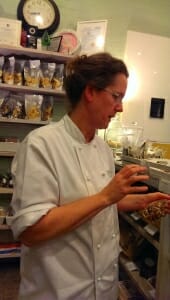




“Bread for us is an emotional product. How do we give it the level of attention it deserves? And how can we present bread in a different way? If we look at conventional bakeries, they stuff the bread on to one shelf. How do we make it a product you really desire, that triggers emotions and also reflect on traditional consumption and connect to bread in a different way?”
“In the last 16 years we measured 5000 women. From that research we found many new results…Why does the body work like this? What does the body do about walking?…The pants show the body. It should be a nice picture and painting. We want to make that possible. That was our purpose. We’ve never been satisfied by anything that is half.”
Because this grape was difficult to grow and not abundant it fell almost completely of production in favor of more abundant varieties. In the 1990s, winemaker Elvio Cogno rediscovered the wine and got it back into production. This was not easy because they had to actually locate and select the plants. The contemporary interest in autochthonous wines provides the support to bring a difficult grape into commercial viability.
For his father’s generation, value meant to save money on inputs. He was buying milk. Francesco sees value as quality. He’s buying cows.
“I don’t do something just for money reasons, but also for quality. For the thing itself. I like single components. I never use any kind of mix. I make it all by myself. I don’t like the tendency in business that you can buy everything ready-made.”
I grew up in an Indian neighborhood in Canada. I loved the food. When I moved here to Berlin I missed it. So I went to study in India. It took a lot of time to adapt the recipes.
Now I have less than 50,000 Kroner, but I used to have sleep problems and pain in my body in my back, arms. Now I’m on my feet all day, but the physical pain is gone. When I’m working, I feel I’m relaxing.
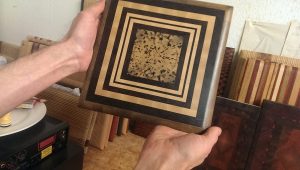
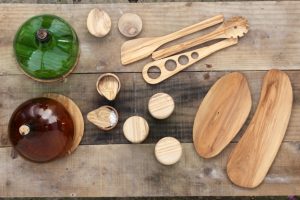
Everybody uses boards, but not like these. Every board should be a combination of art and something to use. Some people put it on the wall or lay it on the table as an object, but for me it’s best if you combine these two things. That you have a place where you can see and touch it, and if it’s needed you use it.
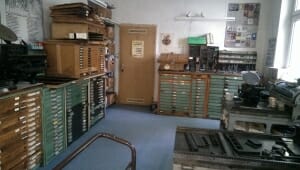
We could see West Berlin. We also could see the soldiers. Directly there I could see on the 9th of November, when the wall was falling down. I could see it from the printing shop.
When the wall was falling down I lost my first job. They cancelled in 1990 the contracts of the young employees.
“We try to keep the distance between the customer and the workshop as short as possible…These are objects that I want to be used. And it should be used hard. That’s what they’re made for…Buying a table takes a long time. It takes months….Most of these people are buying the last table for their life…For me it would be a success if the grandchildren still like the table.
These demonstrations are found by his own research, conversations with product engineers, and through Germany’s network of 300 repair cafés, where participants find the same problems over and over, and take products apart to understand what has gone wrong.
I have a vision in my head and arrogantly I feel like it’s fully formed, but through mistakes, working with your medium, you move, it reacts, you attack it, it responds. It’s like you’re discovering what the guitar is meant to be, rather than manipulating it to your will. And that is a magical process.
Being around food is the easiest thing I’ve ever done. It’s instinctive to me. I want to talk about it. I enjoy sugar as a material, I can express in lots and lots of different ways.
“Because we want to work with artisans. We’re designers. We like to have a process with them, starting from what they do. Each one has a handwriting. But they also have limitations, the way they were trained, usually just one material.”
He explained that he doesn’t try to create something that will sell. “I make what I like.”
He sells at the Berlin artisan market and at some annual artisan markets. “I don’t like selling with shops. First, they take 40% of the money. But also I need to be able to see the people, how they handle it, the questions they ask me. I need to watch. Is it going in her eye?”
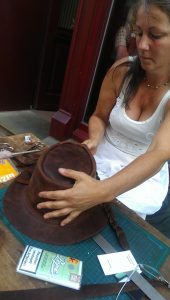
“I began as a teenager to hand make clothes, because in East Germany there were no shops. You had to make something interesting yourself. So I began with normal clothes. Now for 15 years I work with leather.”
“People see eggs and they ask ‘are these barn raised or free range raised?’ ‘Are they organic or not?’ It baffles me that wine is not the same. Where did it come from? How was it grown? Is it organic? People should be interested in the process and provenance of wine, the same way they are with food.”
The farm was back blocks of the conventional farming area, and it was considered scrub country. It wasn’t valued for any purpose, because it was too steep for cattle and totally vegetated. I jumped at the opportunity because to me it had value.
I was a contractor. I bought a hobby lathe on sale. I burned out the motor in 6 months, so I knew I had found my calling. I call it “reclaiming the souls of trees”.
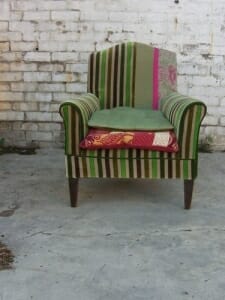
“For a long time I’ve called it a compulsion rather than a business because there are things that I can’t leave on the footpath. Obviously I don’t need any more chairs. You see the potential in something and you know you can make it something that other people will value again, and you can’t pass it up because you know that not everyone can do that or see it until you’ve had your way with it.”
“I am figuring out how to make that difference between obsolete and desirable. What makes desire last a long time? Some of the things I have found are considered to be ‘good design’, even ‘classic’. How do they become unwanted? What gives objects a staying power in desire? What imparts longevity?”
Interview with Melinda Dimitriades. At the time of this interview in 2013 her company was called Farmgate. It’s now Chop Shop Carnivorium. I got into
This is a story is about falling in love with food. It’s about working for something because it’s beautiful, and hoping the money will be enough to keep doing it – a story that I keep running into while distractedly turning a corner. It’s about a search for meaning in the money, connection in the contract.
Yet Mogannam insists that he’s not in it for the money. “I like to feed people,” he says. “I like to have fun. I like to do things that make a difference. Money is secondary. It’s always been secondary, and I think that’s why we’ve been able to do so well.”
Chad Robertson is the bread baker at Tartine, San Francisco. He makes the most beautiful bread he can, because he wants to. He doesn’t try to make too much of it. (Just 175 loaves a day, which sell out in an hour.) He’s analytical, thoughtful, directed, probably brilliant. But he “wants to work with my hands”. Reprint of article from San Francisco Magazine (defunct).